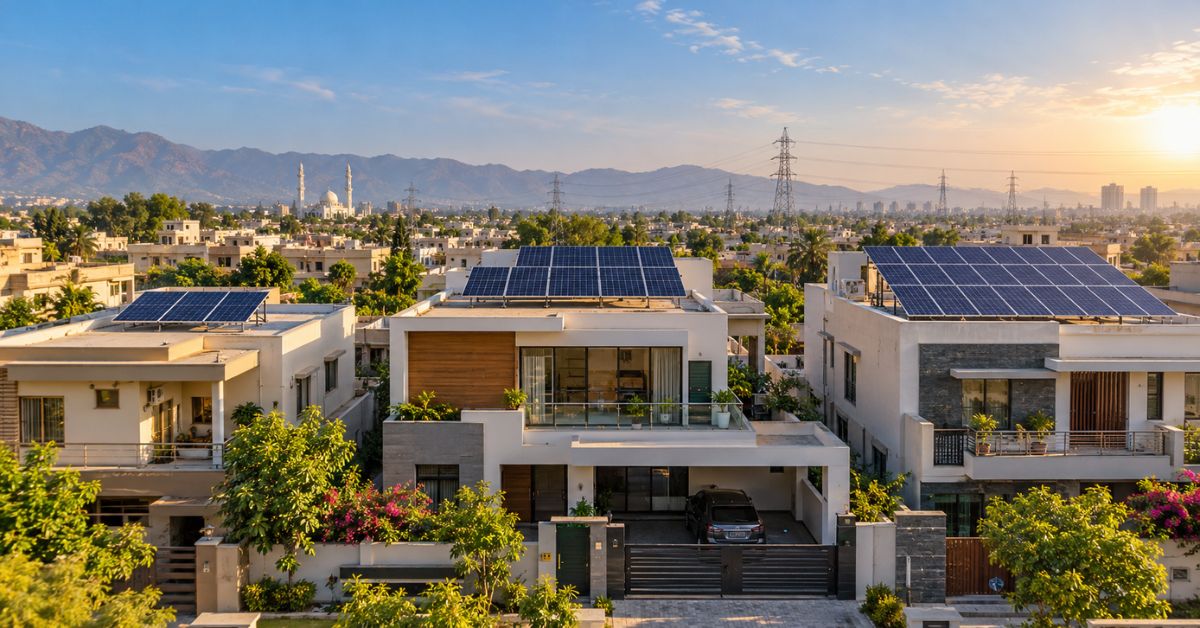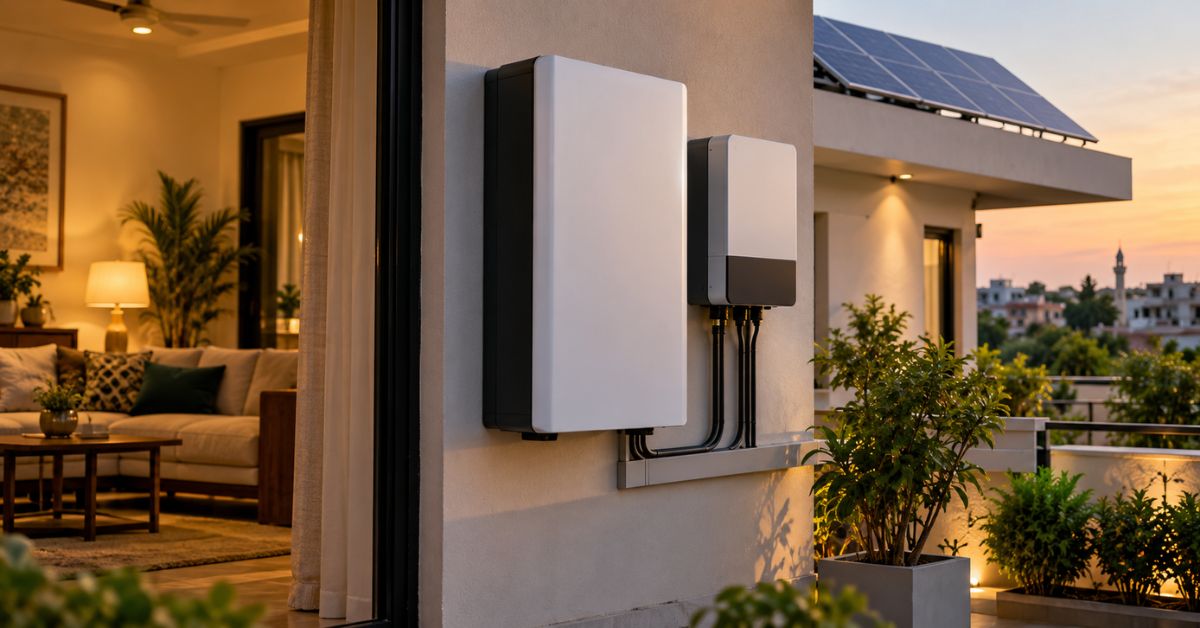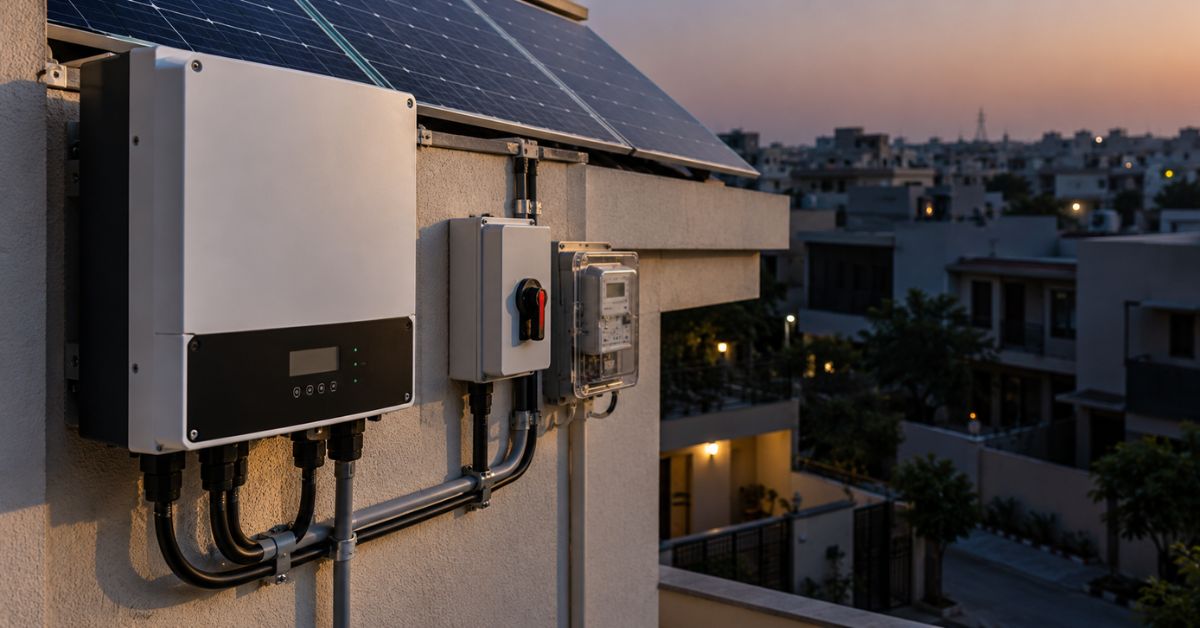
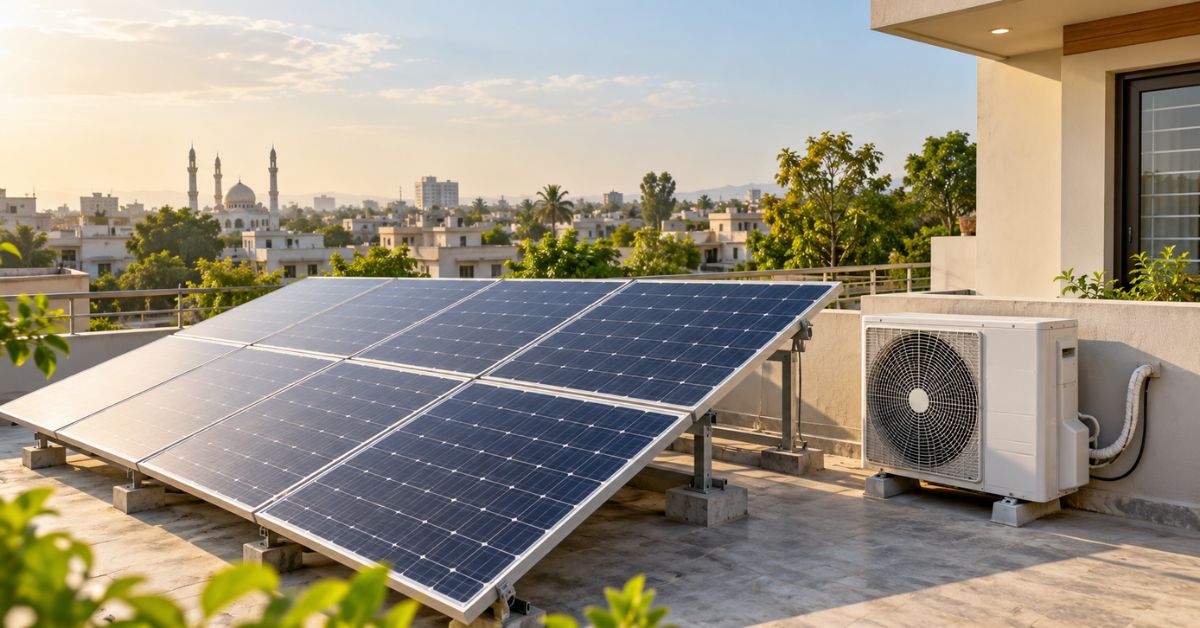
For daytime use in Pakistan, a starting calculation gives four to six panels rated between 550W and 645W for a 1.5 ton AC drawing 1.88–2.21kW.
That is a power estimate for strong sunlight. Longer running hours can require more panels to cover the day's energy use.
AC electrical input used | 550W panels | 645W panels |
|---|---|---|
1,880W | 5 panels | 4 panels |
2,210W | 6 panels | 5 panels |
This comparison assumes 80% of the panels' rated power reaches the AC. It is a calculation assumption, not guaranteed output. Clouds, heat, shade and the actual equipment can change the result.
For six or eight hours of cooling, check the energy calculation below before choosing a final count.
Check the AC's Cooling Input First
Read the label or specification sheet for cooling power input, stated in W or kW. The “1.5 ton” label describes cooling capacity, not electricity consumption.
Published specifications for one 1.5 ton inverter unit list 520–2,210W of cooling input. A fixed-speed 1.5 ton unit lists 1,880W.
Those figures explain why tonnage alone cannot settle the panel count.
An inverter AC can reduce its draw after the room cools. Its lowest advertised input should not be treated as its maximum requirement.
For home solar planning, share the exact AC model and label photo. Use recorded average consumption for daily energy, while checking higher demand for power supply and backup.
How the Panel Calculation Works
Our DHA Phase 6 installation uses 645W panels. That gives us a documented panel rating for the comparison, rather than assuming every module has the same output.
The completed installation contains nine such panels. The calculation below uses the same panel rating.
For the power illustration above:
Panels needed = AC input watts ÷ (panel watts × 0.80).
For the 2,210W input and 645W modules:
2,210 ÷ (645 × 0.80) = 4.28 panels.
Round up to five panels for this calculation.
Four 645W panels would supply about 2,064W under the same assumption. That falls below 2,210W before adding any other appliance.
A panel count that passes this check must still satisfy daily energy needs and inverter requirements.
Six Hours and Eight Hours Need Different Energy Budgets
Running power and daily energy answer different questions. The first checks demand at a particular moment. The second checks consumption across the operating period.
For daily energy:
AC input in kW × running hours = electricity used in kWh.
Japston's sizing estimator uses 3.5 units per installed kW per day as an initial planning assumption. With 645W panels, the calculation becomes:
Continuous AC input | Running time | AC energy required | Energy-only panel estimate |
|---|---|---|---|
2.21kW | 6 hours | 13.26kWh | 6 × 645W panels |
2.21kW | 8 hours | 17.68kWh | 8 × 645W panels |
These are constant-load calculations, not measured household consumption. An inverter AC's average input may be lower.
The counts exclude other appliances and additional battery-charging losses. They also do not promise uninterrupted supply throughout those hours.
Replace the planning assumption with a generation forecast for your roof before ordering equipment.
Your cooling schedule also matters. Six hours around midday do not receive the same sunlight as six hours extending into the evening.
Request expected output across your actual AC hours. A single noon reading cannot show that pattern. Include grid or stored-energy support where solar output falls short.
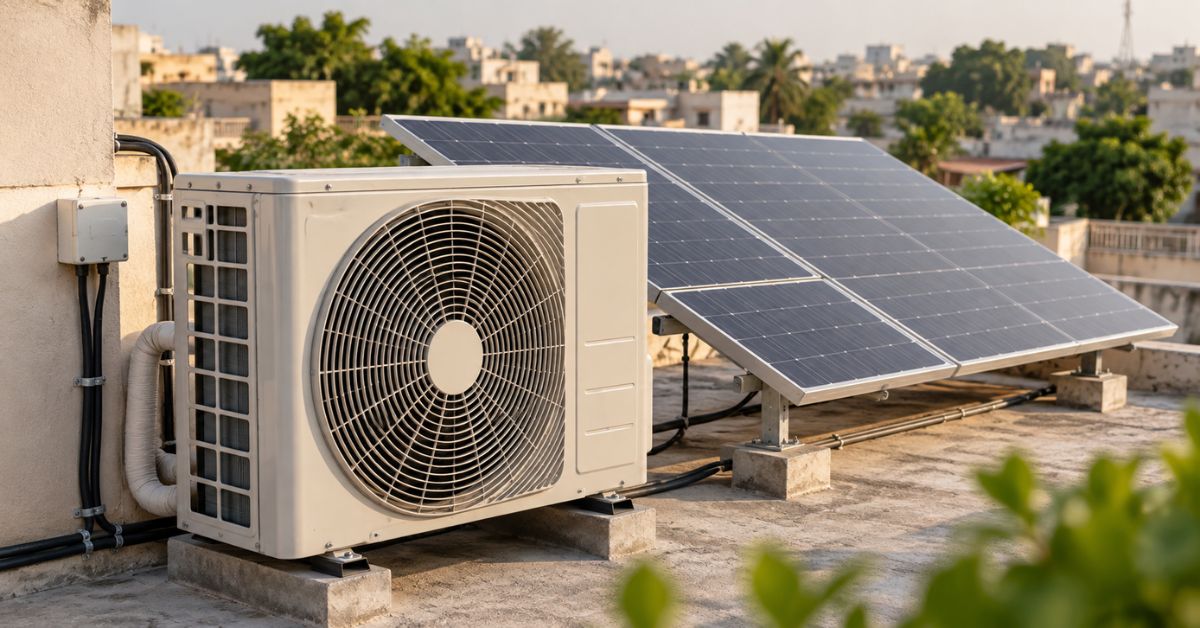
Include the Loads Sharing the Solar System
The opening table allows for the AC alone. It does not reserve power for the rest of the house.
List the appliances that operate while the AC runs. Record their power demand and hours of use.
Add simultaneous demand when checking the inverter and available solar power. Add their daily consumption when checking total generation.
If the grid remains available, it may supply a shortfall, depending on the setup. A smaller array can therefore offset part of the AC's consumption without supplying its entire load.
Make that goal clear in the quotation.
Check the Inverter Before Accepting the Panel Count
Enough panel watts do not automatically mean the proposed connection will work.
The inverter also needs a suitable panel-string voltage. Its startup voltage, tracking range and input-current limits must match the selected modules and wiring arrangement.
This can require a different panel count from the simple calculation.
For backup operation, check continuous output and the AC's starting demand. Fixed-speed compressors need particular attention at startup.
A solar site survey and design assessment should confirm the roof layout and equipment arrangement together. Panel quantity should follow that design.
Nighttime Cooling Requires Stored Energy or Another Supply
Solar panels do not generate electricity after sunset. Nighttime AC use therefore needs grid electricity, battery storage or another supply.
For solar-charged storage, the panels must generate enough energy during daylight to recharge the battery as well as serve daytime loads.
Battery selection also needs usable storage and discharge-power checks. Its printed capacity alone does not establish the hours of cooling available.
Discuss lithium battery backup around your required AC hours. Allow for conversion losses and any other appliances sharing the backup circuits.
Choose Panels Around Your AC's Actual Use
Use four to six 550–645W panels as a conditional daytime starting range. Check the AC's input, panel wattage and available sunlight alongside it.
For longer cooling periods, size daily generation separately. In the stated eight-hour calculation, the energy requirement rises to eight 645W panels.
Send Japston Energy your AC label, city, operating hours and backup needs. Include other appliances and any planned second AC. Those details allow the panel array, inverter and storage to be assessed together.
FAQs
Will two 645W panels run a 1.5 ton AC?
Their combined rating is only 1,290W before losses. That is below both AC inputs used here. They may contribute through a compatible grid-assisted system, but cannot independently meet those loads.
Can I use my existing UPS inverter?
Only if its specifications support the proposed solar input, AC load and backup arrangement. Check the exact model. Its advertised wattage alone is insufficient.
Do higher-wattage panels always need less roof space?
No. They may also be physically larger. Compare dimensions, total array output, shade and access space before choosing the layout.
Can the AC run during load shedding?
A standard on-grid system normally stops supplying power during an outage. Outage operation requires equipment configured for backup. Whether a battery is necessary depends on the exact system.
Should I measure consumption only after the room has cooled?
No. Include the initial cooling period and hotter operating conditions. A low reading from one settled period may understate the power and daily energy the system must support.